For Years 1 to 6. Early access is free for invited families. No adverts or timers.
Maths · Round It
Before you start
Rounding to the nearest 10
Find the two tens the number sits between. Pick the one it is closer to.
30354037
Example 1
23 sits between 20 and 30. It is closer to 20, so it rounds to 20.
Example 2
65 is exactly halfway. Halfway numbers round up, so it rounds to 70.
Start practising
Maths · Round It
From your sheet
Question 3 of 8
Round 47 to the nearest 10.
40✓ 50
Yes. 47 is between 40 and 50, and it is closer to 50.
I don’t know this oneNext
3 tasks found on the sheet
Homework can be hard, for children and for parents.
Often your child is not sure how to start, and you are not always sure how to help.
4 millionparents in the UK regularly argue with their child over homework.¹
1.8 millionpupils in England have special educational needs, such as dyslexia.²
Explained first, then practised, at their own pace
¹ Parentkind National Parent Survey 2024, by YouGov with 5,490 parents.
² Department for Education, Special educational needs in England, 2025/26.
How it works
Found on the sheet
3 tasks
Spellings
4 words
Rounding
3 sums
Commas
1 sentence
Looks right
1
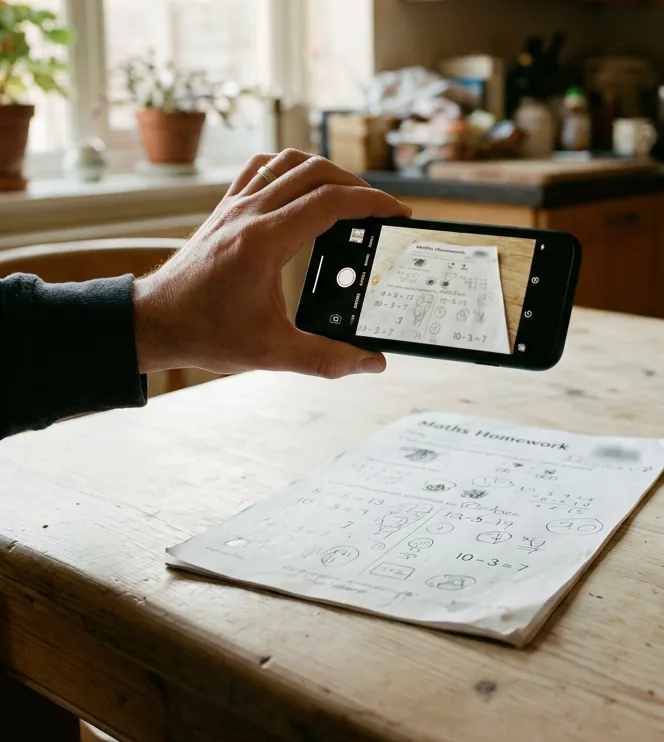
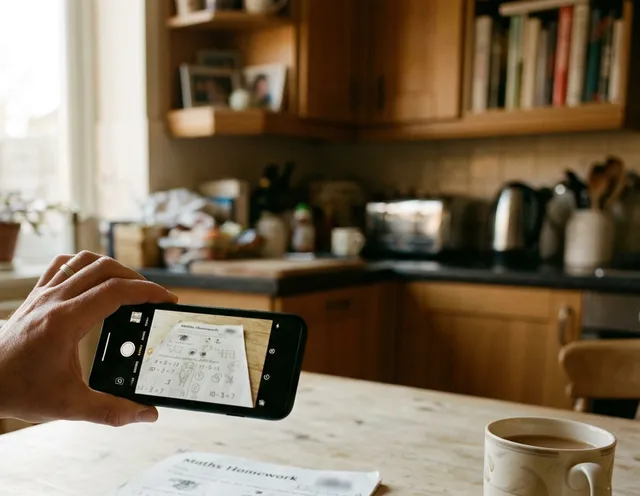
Take a photo of the sheet
On your phone, or add the file if school emailed it. You check what we read before anything is built.
This week for Orla
4 activities
Spelling · About 6 minutes
Word Detective
✓ Done
Maths · About 6 minutes
Round It
Writing · About 5 minutes
Tap the spot
Mixed · About 8 minutes
Mixed practice
2
We explain each skill
Each activity starts with a short explanation and worked examples. Then come short activities made from the sheet.
One thing worth a look this week
Orla chose “their” when the answer was “there” in 4 of 6 questions.
The two words sound the same, so they are easy to mix up. Try this at tea: take turns saying a sentence with “there” and pointing to a place.
How Orla felt
A bit worried about spellings, fine about maths
3
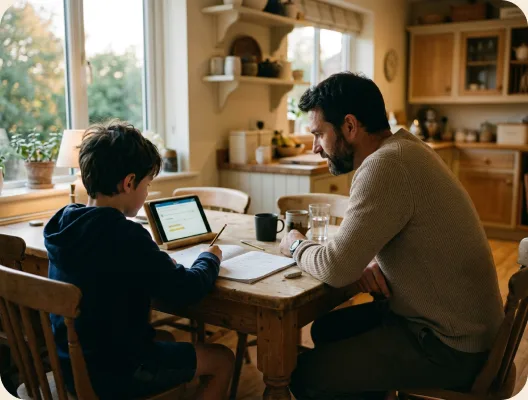
They practise, you hear
About 20 minutes a sitting. On Friday, one thing worth a look and how they felt.
AI only reads the photo of the sheet. Your child never talks to it.
Why it helps
What your child sees during the week, and what you get on Friday.
Your child knows how to begin
Before any questions, a short explanation and two worked examples, using the words and sums from their own sheet.
Spelling · Word Detective
Before you start
there, their and they’re
They sound the same but mean different things. Your teacher calls them homophones.
there
a place: Put it over there.
their
belongs to them: their coats
they’re
they are: They’re late.
Tip
“there” has “here” inside it, and here is a place too.
Start practising
Spelling · Word Detective
From your sheet
Question 1 of 6
Which word fits? We left our bags over ___.
theretheirthey’re
Nothing to race against
Nothing counts down, and missing a day costs nothing. Every answer comes with the reason, and “I don’t know this one” is always ok to tap.
Before you start
How do you feel about commas today?
FineA bit worriedNot sure
Writing · Tap the spot
From your sheet
Question 4 of 6
Tap where the missing comma goes.
I packed a hat a coat, and a scarf.
Not quite
In a list, the comma goes between the things, and there is usually no comma before “and”. Try the gap after “hat”.
I don’t know this oneTry again
One thing worth a look, and how they felt
One email on Friday with the answer that keeps getting mixed up, the likely reason, and something to try at tea.
One thing worth a look this week
Orla chose “their” when the answer was “there” in 4 of 6 questions.
The two words sound the same, so they are easy to mix up. Try this at tea: take turns saying a sentence with “there” and pointing to a place.
How each subject went this week
How Orla felt before starting: a bit worried about spellings
Set up the way your child reads best
Made for children who find reading hard. Every feature is included at no extra cost.
Reading settings for Orla
Grown-ups
Text size
AaNormalAaBigAaBiggest
Colours
Cream
Round 47 to the nearest 10.
Night
Round 47 to the nearest 10.
Read it to me
Read each screen aloud
Normal speedSlow
Letters
b d p q 6 9 I l 1
Atkinson Hyperlegible Next, made so letters that look alike are easy to tell apart.
Spelling · Word Detective
Which word fits? We left our bags over ___.
theretheirthey’re
Read it to me
Read it to me
Any screen, read aloud, at normal or slow speed.
Clear letters
A typeface the Braille Institute designed so easily confused letters look different.
Cream or Night
Cream by default, as dyslexia guidance advises.
Big buttons, little typing
Sized for children’s fingers. Single words and numbers only.
There are three text sizes and calm screens, and the app follows the British Dyslexia Association style guide.
The family behind Little Known
Why we made Little Known
Dyslexia runs in our family. My wife and her father both struggled with it at school.
When our son started bringing homework home, we soon found that school can only do so much. The rest of the help had to come from us.
We did not want him to struggle the way they did. So we built something that lets him practise the work he was actually set, at his own pace, without a clock or a score hanging over him. Our son uses it every week.
How Brave Beginnings started
Katia founded Brave Beginnings to support the mental wellbeing of children and young people. She has a background in paediatric nursing and child and adolescent mental health, and has worked with families in New Zealand, South Africa and the United Kingdom.
She is trained in LEGO®-based therapy and low-intensity cognitive behavioural therapy (CBT). Little Known brings that thinking to homework. Each week it asks your child how they feel.
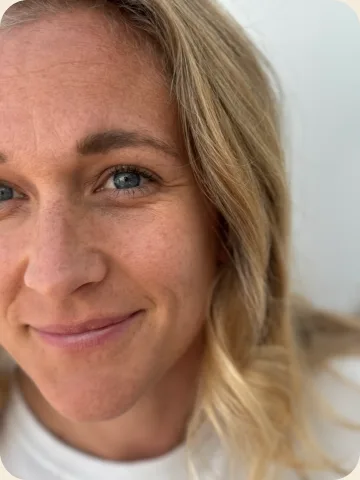
Katia Grobecker, founder of Brave Beginnings
Keeping your child safe
Photos are deleted
We delete the photo once the week’s practice is built.
No chatting with AI
We use AI in the background to read the photo. Your child never talks to it.
A PIN for grown-ups
Your child cannot open it, and the app tells them that you can see how they are getting on.
Only a first name
That is all we ask about your child. We do not ask for a surname, school or date of birth, and we never sell data.
No. AI only reads the photo you send. Your child never chats with it, and the only things they type are single words and numbers.
Which year groups is it for?
Years 1 to 6 (ages 5 to 11), for maths and English homework.
Is it for children with dyslexia?
It is made for any child who finds homework hard, including children with dyslexia. It is easy to read and can read every screen aloud. It is practice at home and is not a treatment.
Will it work with my child’s homework?
It is built for maths and English sheets: spellings, sums, grammar and punctuation. If a sheet has something Little Known cannot make, such as a link to a website, it tells you and suggests an activity instead.
Is this more screen time?
About 20 minutes a sitting, then it is done. There are no adverts, videos or rewards to keep your child on it. UK paediatricians found no evidence that homework on a screen is more harmful than homework on paper.
What happens to the photo of the homework?
An AI service in the United States reads it. We delete our copy once the week’s practice is built, and the AI service deletes its copy within 30 days. It is never used to train AI.
Does it replace support from school?
No. It helps your child practise the work their school set. Any extra support your child needs is still agreed with their school.
You know more than you think.
And so does your child. We are inviting a small group of families to try it free while we test it.